



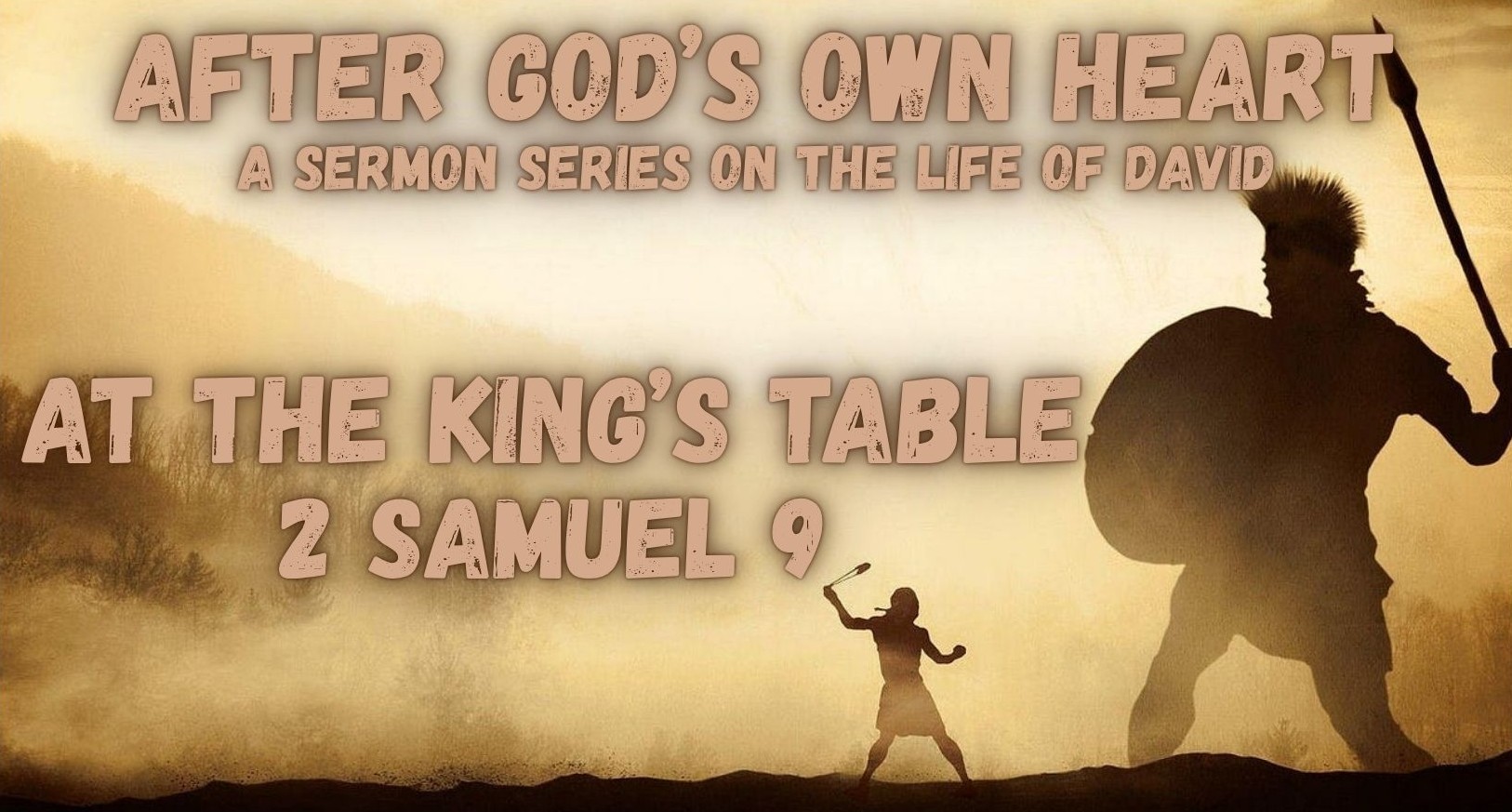
2 Samuel 9:1-13
And David said, Is there yet any that is left of the house of Saul, that I may shew him kindness for Jonathan’s sake? 2 And there was of the house of Saul a servant whose name was Ziba. And when they had called him unto David, the king said unto him, Art thou Ziba? And he said, Thy servant is he. 3 And the king said, Is there not yet any of the house of Saul, that I may shew the kindness of God unto him? And Ziba said unto the king, Jonathan hath yet a son, which is lame on his feet. 4 And the king said unto him, Where is he? And Ziba said unto the king, Behold, he is in the house of Machir, the son of Ammiel, in Lodebar. 5 Then king David sent, and fetched him out of the house of Machir, the son of Ammiel, from Lodebar. 6 Now when Mephibosheth, the son of Jonathan, the son of Saul, was come unto David, he fell on his face, and did reverence. And David said, Mephibosheth. And he answered, Behold thy servant! 7 And David said unto him, Fear not: for I will surely shew thee kindness for Jonathan thy father’s sake, and will restore thee all the land of Saul thy father; and thou shalt eat bread at my table continually. 8 And he bowed himself, and said, What is thy servant, that thou shouldest look upon such a dead dog as I am? 9 Then the king called to Ziba, Saul’s servant, and said unto him, I have given unto thy master’s son all that pertained to Saul and to all his house. 10 Thou therefore, and thy sons, and thy servants, shall till the land for him, and thou shalt bring in the fruits, that thy master’s son may have food to eat: but Mephibosheth thy master’s son shall eat bread alway at my table. Now Ziba had fifteen sons and twenty servants. 11 Then said Ziba unto the king, According to all that my lord the king hath commanded his servant, so shall thy servant do. As for Mephibosheth, said the king, he shall eat at my table, as one of the king’s sons. 12 And Mephibosheth had a young son, whose name was Micha. And all that dwelt in the house of Ziba were servants unto Mephibosheth. 13 So Mephibosheth dwelt in Jerusalem: for he did eat continually at the king’s table; and was lame on both his feet.
The essential mark of saving faith is a transformed heart lived out in a transformed life. 2 Corinthians 5:17 says, “Therefore if any man be in Christ, he is a new creature: old things are passed away; behold, all things are become new.” While David’s life was marked by highs and lows, failures and successes, and even sin and righteousness, David’s heart for the Lord was made evident through it all as a man who truly walked with the Lord. 2 Samuel 6-9 records a period of David’s life that best reflects that. In 2 Samuel 6-7, we saw his heart for worship as he had the ark of the Lord moved to Jerusalem and had a desire to build the Lord a temple. In 2 Samuel 8, we saw his heart for obeying the Lord and carrying out the Lord’s will in the kingdom of Israel as he led Israel to expand the borders to the places where God had originally promised to Abraham. Now, in 2 Samuel 9, we see an instance where David best reflects the character of God by showing mercy in his personal relationships. David’s dealings with Mephibosheth in this chapter demonstrate the heart and mercy of the Lord Jesus Christ shown toward sinners who trust in Him. David would extend covenantal mercy and kindness to an undeserving member of Saul’s household, the crippled son of Jonathan named Mephibosheth. In doing so, he demonstrated that he had come to know the Lord’s grace and mercy in his own life and desired to extend it to others. Mephibosheth would be taken from being an outcast in hiding to an individual who sat and ate at the king’s table. From David’s dealings toward Mephibosheth, we see three things modeled that reflect the actions of the Lord Jesus toward sinners who put their trust in Him.
First, we see that our King keeps His promises. After a period of victorious conquests, David once again had a period to reflect on unfinished business. This time, his focus was drawn to promises that he had made to both Saul (1 Samuel 24:21-22) and Jonathan (1 Samuel 20:14-17) that he would not “cut off” Saul’s descendants and instead extend covenantal love and faithfulness to Jonathan’s descendants. Typically, a king would cut off all of those in the family of the previous regime, but David was a different kind of king in a different kingdom. In God’s kingdom, character is at the highest of premiums and David’s character needed to reflect the character of the Lord who had called him. In the same way that God had shown covenantal love and faithfulness to him and the nation of Israel, David would honor his covenant promises that had been made with Jonathan and Saul. The word “kindness” that is used here is the same word found elsewhere in 1 and 2 Samuel to describe God’s faithful love and mercy toward His people. David’s desire was to fulfill his word to Jonathan and Saul and extend that “kindness” to their descendants. While three of Saul’s sons had died with him in 1 Samuel 31 and Ish-bosheth had been murdered in 2 Samuel 4, David inquired to see if anyone was left from Jonathan’s household that he could keep this promise toward. The only living relative that remained was the lame son of Jonathan named Mephibosheth. He was first introduced back in 2 Samuel 4 in light of Ish-bosheth’s coming murder to remind us that God had not removed all of Saul and Jonathan’s descendants, thus allowing David to keep his promise. Being lame was a shameful thing. It actually prevented Mephibosheth from being a real threat to the throne for the people would never follow a crippled king. He had become lame because he was dropped when his family tried to escape upon the deaths of Saul and his sons. When David called for him, Mephibosheth was living in “Lodebar,” which means “no pasture.” He was a lame man from a barren place with nothing to offer. Notice that David does not ask, “Is there anyone qualified?” or “Is there anyone worthy?” Instead, he asks, “Is there anyone?” This did not depend upon Mephibosheth’s condition, but upon David’s promise and the Lord’s will. In the same way, our salvation and standing before God depend not upon our standing, but upon the Word of our King Jesus. Just as Mephibosheth was once royalty, you and I are descended from Adam and are made in the image of God. Just as Mephibosheth was dropped and made lame, you and I have been corrupted by sin and made unfit. Just as Mephibosheth lived in a place whose name meant “no pasture,” you and I live in a fallen world marred by sin and the curse. Just as Mephibosheth came from a lineage that would normally be at war with the current king, you and I are naturally “enemies” of God (Romans 5:10). Just as Mephibosheth was helpless to do anything to fix his situation, you and I are helpless to save ourselves from sin. Like him, our hope rests not in us, but in the character of our King and His promises.
Next, we see that our King gives grace to the humble. The only proper response to God’s grace in our lives is humility. We see such a response from Mephibosheth to David for David’s kindness toward him. He does three things that show humility. First, “he fell on his face, and did reverence.” Second, he declared himself to be David’s servant (v. 6). Lastly, “he bowed himself, and said, What is thy servant, that thou shouldest look upon such a dead dog as I am?” (v. 8). He took the proper posture and recognized David as king. He declared himself a humble servant and he saw himself as unworthy of David’s mercy. Can you imagine what went through Mephibosheth’s mind when he saw an entourage from the king arrive to take him to David? Being a descendant from the previous regime, the last thing he wanted to have meet him were messengers from the king. He was likely terrified because he had spent the last many years of his life hiding from David. When he showed up to David, he likely expected a sword to his neck, but instead received a remarkable promise of acceptance and grace. Instead of being cut off from the land of the living, he would be given a seat at the king’s table. His humble response is the only proper response to grace. It is the response that you and I must have to God’s grace. When Jesus’s disciples were arguing once about which of them would be the greatest in God’s kingdom, Jesus took a child, set him in their midst and said, “Except ye be converted, and become as little children, ye shall not enter into the kingdom of heaven. Whosoever therefore shall humble himself as this little child, the same is greatest in the kingdom of heaven” (Matthew 18:3-4). The kingdom of God belongs to the humble; to the “poor in spirit” (Matthew 5:3). The Bible is full of instructions about being humble before God. 1 Peter 5:5 says, “be clothed with humility: for God resisteth the proud, and giveth grace to the humble.” In Isaiah 66:2, He tells us “but to this man will I look, even to him that is poor and of a contrite spirit, and trembleth at my word.” The Lord shows mercy and grace to the humble.
Lastly, we see that our King provides for His servants. In verses 9-13 we see that David promised to continually provide for Mephibosheth. He gave Mephibosheth Saul’s land and he appointed Ziba, who had fifteen sons and twenty servants, to tend it all and harvest the crops from it. This was intended to provide for Mephibosheth and his descendants (he had a son named Micha – v. 12) perhaps for generations, but Mephibosheth himself lived in Jerusalem and ate at David’s table continually (v. 13). This promise of provision mirrors that of Christ’s promise to meet the physical needs of His followers who serve Him (Matthew 6:25-33). It also points to the fact that He has “given unto us all things that pertain unto life and godliness” (2 Peter 1:3). He has “blessed us with all spiritual blessings in heavenly places in Christ” (Ephesians 1:3). He has provided everything needed for our salvation and for us to live lives of service to Him. In addition, He has given us an open invitation to “come boldly unto the throne of grace, that we may obtain mercy, and find grace to help in time of need” (Hebrews 4:16). He takes us who were dead in sin (Ephesians 2:1) and made us children of the King of heaven. Now we enjoy the fellowship and blessing of eating at His table by walking with Him, but one day, He will bring us into an eternal dwelling place where we will eat at His table forever. He has made every provision for us to successfully bring us to that place.
Our King has given us an invitation to come and eat continually at His table. We who are unworthy of this honor and unable to stand on our own have been called out of the darkness of this world to the kingdom of God (Colossians 1:12). We have not just been forgiven, but we have been adopted into the King’s family. We have been given the highest of standings as children of God. Our King keeps His promises. Our King gives grace to the humble. Our King provides for His servants. Let us hear the invitation of our King when He described a man holding a banquet and calling out, “Come; for all things are now ready” (Luke 14:17). The table is set and He bids us “Come.” Come and claim His promises. Come and humbly receive His grace. Come and trust in His provision.