



2 Samuel 6:1-11
Again, David gathered together all the chosen men of Israel, thirty thousand. 2 And David arose, and went with all the people that were with him from Baale of Judah, to bring up from thence the ark of God, whose name is called by the name of the Lord of hosts that dwelleth between the cherubims. 3 And they set the ark of God upon a new cart, and brought it out of the house of Abinadab that was in Gibeah: and Uzzah and Ahio, the sons of Abinadab, drave the new cart. 4 And they brought it out of the house of Abinadab which was at Gibeah, accompanying the ark of God: and Ahio went before the ark. 5 And David and all the house of Israel played before the Lord on all manner of instruments made of fir wood, even on harps, and on psalteries, and on timbrels, and on cornets, and on cymbals. 6 And when they came to Nachon’s threshingfloor, Uzzah put forth his hand to the ark of God, and took hold of it; for the oxen shook it. 7 And the anger of the Lord was kindled against Uzzah; and God smote him there for his error; and there he died by the ark of God. 8 And David was displeased, because the Lord had made a breach upon Uzzah: and he called the name of the place Perezuzzah to this day. 9 And David was afraid of the Lord that day, and said, How shall the ark of the Lord come to me? 10 So David would not remove the ark of the Lord unto him into the city of David: but David carried it aside into the house of Obededom the Gittite. 11 And the ark of the Lord continued in the house of Obededom the Gittite three months: and the Lord blessed Obededom, and all his household.
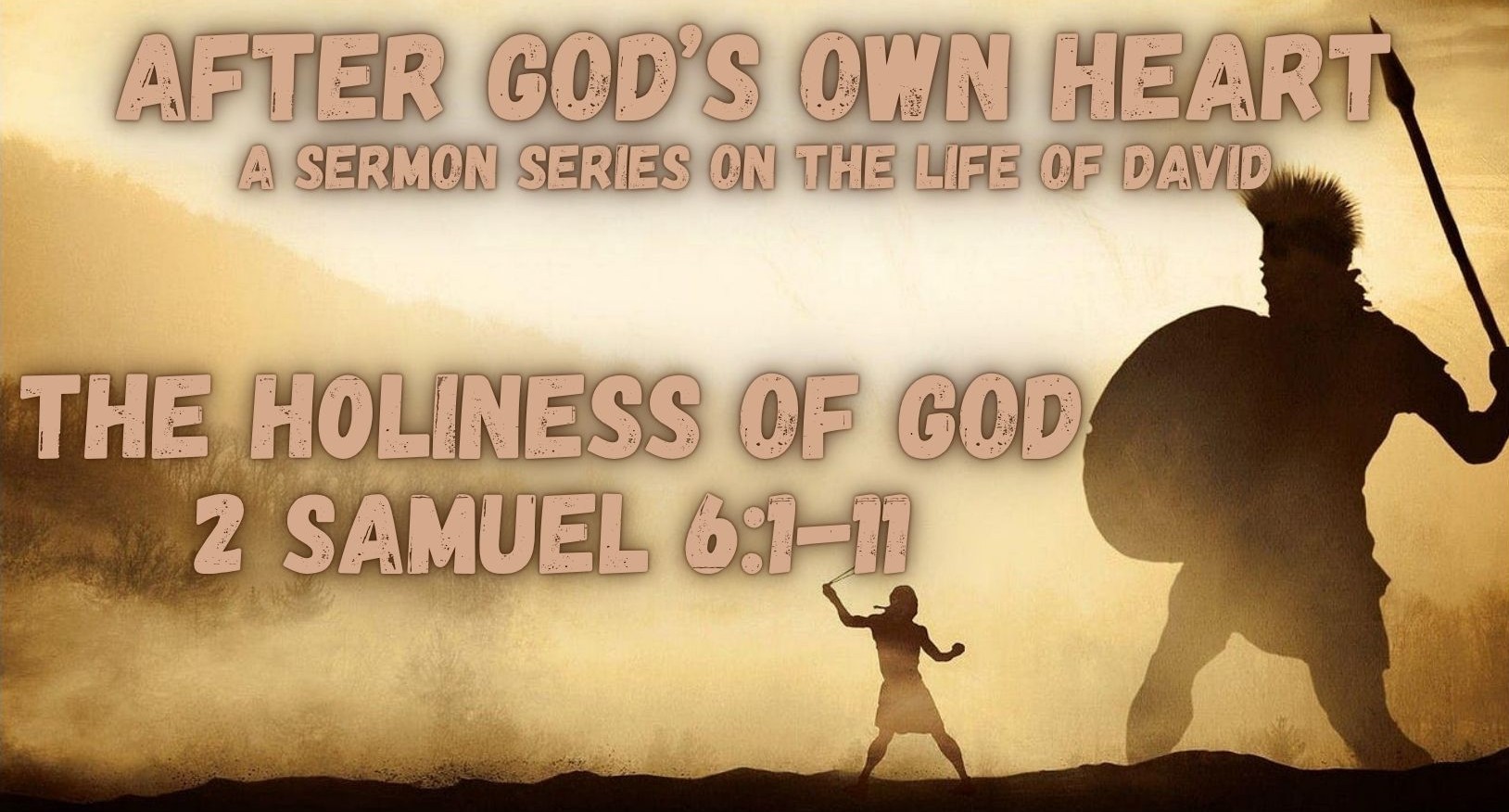
God’s King, the Lord Jesus, reigns. His King is establishing right worship in the hearts of His people today. Last week, we looked into the rule of King David and one of his early actions as king over all of Israel in moving the ark to Jerusalem to establish proper worship of Yahweh, something Israel had not had for decades. In regards to this matter, David’s example has a lot to teach us about God’s holiness as we consider this matter of true worship. “Holy” is the only attribute of God given a threefold repetition in Scripture. The Seraphim that Isaiah saw in Isaiah 6:1-5 cried “Holy, holy, holy, is the Lord of hosts: the whole earth is full of his glory.” Repetition means emphasis. For something to be given a threefold repetition was to establish the ultimate emphasis. By saying that God is thrice holy, the Bible teaches us that holiness is absolutely essential to who God is and all that He does. He is the perfection of holiness. What does holy mean? The word that it is translated from comes from a root that means “to cut.” It has to do with separation. Holiness for us means separation from sin. Holiness for God certainly includes His moral purity and perfection, but it also describes His uniqueness. He is separate and “other than” all else that exists. There is nothing like Him. In moving the ark from Kiriathjearim to Jerusalem, David and his men would learn a very hard lesson about the holiness of God. God would visibly and powerfully show Himself as holy. 2 Samuel 6:1-11 is about God’s holiness on display. If God’s king were going to establish proper worship of Him, he and all of Israel would have to learn who God is in His holiness. Last week, we learned about David’s failure to have the ark transported according to God’s prescribed way and were reminded that God’s holiness first commands obedience. In failing to obey God, we will see this week as we move forward in the passage that this extracted a heavy toll for one individual. This week, we will continue in 2 Samuel 6:1-11 and learn about two more implications of worshipping God in holiness.
The second thing that God’s holiness calls for in worship is that it demands reverence. What does worshipping God our way produce? The answer is given in verses 6-7…sin and death. Verse 6 tells us what Uzzah did. At some point in transporting the ark on the cart, the oxen stumbled or did something to shake the cart. No doubt, in fear that the ark would tip over off the cart, Uzzah reached out his hand to steady the ark. For most of us, as we read verse 6, we are left thinking that Uzzah has done the practical and right thing. He has heroically kept the ark from tipping over and falling to the ground. However, verse 7 shows us what happened as a result of his actions. Three things happened as a result of him touching the ark: God was angry, God struck Uzzah, and Uzzah died. Notice something specific in the text of verse 7. It says that “the anger of the Lord was kindled against Uzzah” not” the anger of the Lord was kindled against Uzzah’s sin.” God did not divorce Uzzah’s sin from Uzzah. What was the big deal? What was the sin? Well, the law clearly dictated that no one could touch the holy things of the Lord without the consequence of death (Numbers 4:15). This is why the ark was to be wrapped in the veil to the holy of holies (Numbers 4:5). This protected anyone from touching the ark itself or looking upon it unwarranted. Uzzah directly violated God’s Word to do a seemingly “good” thing. The problem is that, while we may consider it good and practical to keep the ark from hitting the ground, what ended up happening to the ark was far worse; Uzzah’s hand touched the ark. Did you catch that? Uzzah’s hand was worse than the ground. Uzzah’s great problem and our great problem is that we don’t see ourselves for who we truly are and this comes as a result of not reverencing God for who He is. If Uzzah had truly known who he was, he would have never thought to step up and steady the ark. Why? It is because Uzzah was more unclean than the ground he sought to protect the ark from touching. It was worse for the ark to touch Uzzah than for the ark to touch the ground. While ground was influenced by the curse that came from the fall in Genesis 3:17-19, the ground had never defied God. It had never sinned against the Lord, yet every human being has sinned against the Lord and rebelled against Him. We are far more unclean than the ground that has never disobeyed the Lord. God made it clear by his response to Uzzah that no act of disobedience can be excused because of pragmatism or good intentions. In fact, if we really think about it, Uzzah’s actions were driven by the pride of thinking too highly of himself – that he was more holy than the dirt. Consider the consequence of where the failure to consider God’s Word that we talked about in verses 1-5 led. By failing to consult Scripture, the ark was transported incorrectly using the world’s methods. This disobedience led to another act of disobedience and the consequence of death for Uzzah. As a result, the place was called “Perezuzzah” because the Lord “broke out” (meaning of Perez) against Uzzah there. In response, we read that David became angry.. Why was he angry with God over all this? It is because he had thought within himself (ignorantly) to be doing the right thing. He must have asked, why would the Lord punish Uzzah for being a part of restoring proper worship of God? The answer is simple. The Lord punished Uzzah for disobedience and violating His Word. David’s anger showed his lack of proper reverence for the Lord. David looked at the situation and concluded that returning the ark was too dangerous of an endeavor and so, he had the ark turned aside to the house of Obededom. David figured that the ark was too dangerous to finish the task. While David got the point of reverencing the Lord, it is not truly reverence to put off serving God altogether because we don’t get our way or realize we were wrong about something. Compromising the task is not the answer. Instead, diligence to study God’s Word, seek His will, and know His will in how we should serve is the proper response of reverence.
The last thing we find in this passage that God’s holiness does in worship is that it brings blessing. Gittites were generally understood to be from Gath. It is possible that Obededom was located in Philistine territory south of Judah. If that is so, it is likely that Obededom was a Philistine that became loyal to David during his time in Gath and Ziklag serving Achish (David had 600 Gittites in his army in 2 Samuel 15:18). It is possible that God was demonstrating His grace in this whole matter through a Gentile household. However, Obededom is also mentioned in 1 Chronicles 15:18 as a Levite and it is possible that (as a Gittite, meaning from Gath) he was from another Gath like Gathrimmon. Regardless, Obededom (whether Gentile or not) was blessed because of God’s presence. What was the blessing? We are not told here, but in 1 Chronicles 26:4-8, his sons are listed out and the passage tells us that they were “able men for strength for the service.” He was blessed with sons (62 total men listed in his family tree there) who served the Lord. Throughout the Old Testament, God blessed people, including Gentiles, for His people’s sake and His presence with His people. Laban was blessed because Jacob served (Genesis 30:27). Potiphar was blessed because of Joseph’s service (Genesis 39:5). The woman of Zarephath was blessed because of Elijah (1 Kings 17:8-24). The Shunammite woman was blessed because of Elisha (2 Kings 4). How much more blessed are we because Christ lives in us (2 Corinthians 13:5)? God was teaching David and Israel a lesson. His holy presence with them was not meant to be a curse, but a blessing. He demonstrated that through His blessing of Obededom. The “curse” of the whole matter was not God’s holiness, but David and Israel’s disobedience. Disobedience and sin brought disaster. God’s presence brings blessing. God’s holiness brings blessing. In fact, life without holiness and without God’s presence is not living at all. It is quite literally death (Ephesians 2:1-3). All of God’s goodness is found in His holy presence. Hell is not so much the absence of God, but the withdrawal of God’s goodness and love. It is a place where His wrath is experienced instead. Rather than shrinking back in fear and inactivity, God’s holiness should drive us to pursue Him in the Way He has given. He has given us His Son who graciously makes us His dwelling place. We no longer follow or go to the ark. God’s ark, the Lord Jesus, dwells in us. True worship is not in a place, but is found in us in Spirit and in truth (John 4:23-24). What a blessing!
David, Israel, and Uzzah’s disobedience brought death. Rather than being the end of the story, God graciously demonstrated that His holy presence among His people was meant to bring life and blessing. David had to learn these three valuable lessons that God’s holiness commands obedience, demands reverence, and brings blessing. If David, as God’s anointed king, would lead Israel in worshipping the Lord, he would have to learn these things for himself. For you and I who have the holy presence of God in us now as believers, how should this impact our lives? We must understand that our lives are no longer our own, but we should conduct ourselves in obedience and reverence, walking in the blessing of the Lord’s holy presence (1 Peter 1:17-19). What areas of your life do you need to yield in obedience to Christ? What things need to be refrained from? What areas of action have been limited by fear instead of motivated by diligently searching the Scriptures for the Lord’s will?