



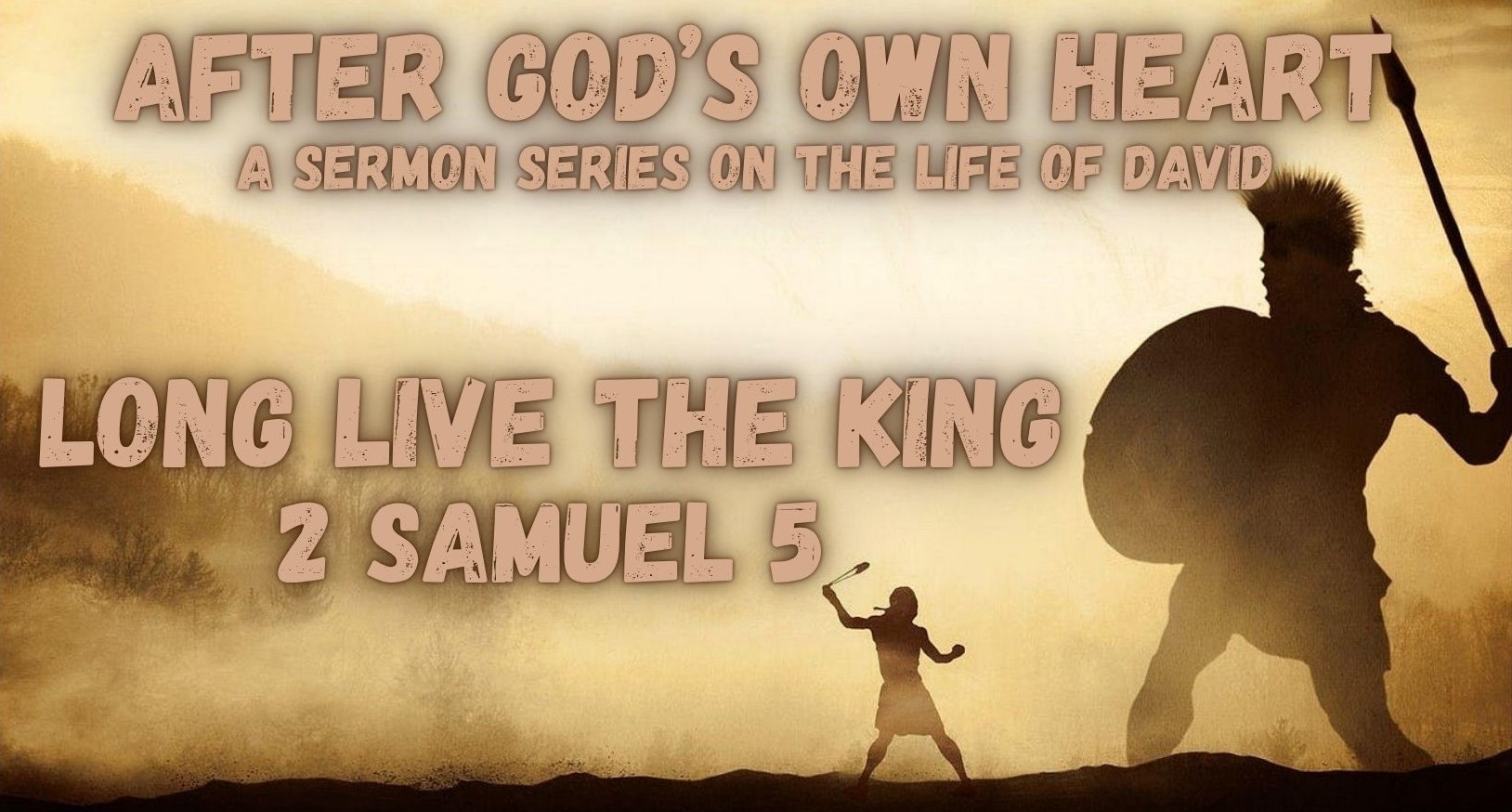
2 Samuel 5:1-25
Then came all the tribes of Israel to David unto Hebron, and spake, saying, Behold, we are thy bone and thy flesh. 2 Also in time past, when Saul was king over us, thou wast he that leddest out and broughtest in Israel: and the Lord said to thee, Thou shalt feed my people Israel, and thou shalt be a captain over Israel. 3 So all the elders of Israel came to the king to Hebron; and king David made a league with them in Hebron before the Lord: and they anointed David king over Israel. 4 David was thirty years old when he began to reign, and he reigned forty years. 5 In Hebron he reigned over Judah seven years and six months: and in Jerusalem he reigned thirty and three years over all Israel and Judah. 6 And the king and his men went to Jerusalem unto the Jebusites, the inhabitants of the land: which spake unto David, saying, Except thou take away the blind and the lame, thou shalt not come in hither: thinking, David cannot come in hither. 7 Nevertheless David took the strong hold of Zion: the same is the city of David. 8 And David said on that day, Whosoever getteth up to the gutter, and smiteth the Jebusites, and the lame and the blind that are hated of David’s soul, he shall be chief and captain. Wherefore they said, The blind and the lame shall not come into the house. 9 So David dwelt in the fort, and called it the city of David. And David built round about from Millo and inward. 10 And David went on, and grew great, and the Lord God of hosts was with him. 11 And Hiram king of Tyre sent messengers to David, and cedar trees, and carpenters, and masons: and they built David an house. 12 And David perceived that the Lord had established him king over Israel, and that he had exalted his kingdom for his people Israel’s sake. 13 And David took him more concubines and wives out of Jerusalem, after he was come from Hebron: and there were yet sons and daughters born to David. 14 And these be the names of those that were born unto him in Jerusalem; Shammuah, and Shobab, and Nathan, and Solomon, 15 Ibhar also, and Elishua, and Nepheg, and Japhia, 16 And Elishama, and Eliada, and Eliphalet. 17 But when the Philistines heard that they had anointed David king over Israel, all the Philistines came up to seek David; and David heard of it, and went down to the hold. 18 The Philistines also came and spread themselves in the valley of Rephaim. 19 And David enquired of the Lord, saying, Shall I go up to the Philistines? wilt thou deliver them into mine hand? And the Lord said unto David, Go up: for I will doubtless deliver the Philistines into thine hand. 20 And David came to Baalperazim, and David smote them there, and said, The Lord hath broken forth upon mine enemies before me, as the breach of waters. Therefore he called the name of that place Baalperazim. 21 And there they left their images, and David and his men burned them. 22 And the Philistines came up yet again, and spread themselves in the valley of Rephaim. 23 And when David enquired of the Lord, he said, Thou shalt not go up; but fetch a compass behind them, and come upon them over against the mulberry trees. 24 And let it be, when thou hearest the sound of a going in the tops of the mulberry trees, that then thou shalt bestir thyself: for then shall the Lord go out before thee, to smite the host of the Philistines. 25 And David did so, as the Lord had commanded him; and smote the Philistines from Geba until thou come to Gazer.
One of the most powerful truths found anywhere in the Bible is “and the Lord God of hosts was with him” (2 Samuel 5:10). That is how the first portion of 2 Samuel 5 ends. Last week, we learned that David was finally been recognized as king over all of Israel and then went about to conquer Jerusalem from the Jebusites. David’s success in being made king and then serving faithfully as king was because God was with him. David’s life serves as a model for us as we seek to serve our King, the Lord Jesus. Last week, we learned that this first means we must believe God’s promises. The elders of Israel submitted to the Word of the Lord concerning David and the promises of God to David regarding him being king were fulfilled. David shows us that if we truly believe God’s promises, then we will wait on His will. Waiting does not mean that we sit around and do nothing. Instead, waiting is about being obedient in matters where we know what we should do and leaving everything else in the Lord’s hands. David never tried to take matters into his own hands to become king. Instead, he left the ordering of all of that to the Lord. When the time was right and as David acted with godly character in handling his enemies, the enemies and obstacles to his rule were gradually removed and the Lord moved the hearts of the people of Israel to eventually embrace him as king. David also demonstrates for us that, if we believe God’s promises we must also be ready to act according to His will. After becoming king, the first action that we read about in 2 Samuel 5 is that he went and conquered Jerusalem from the Jebusites. He knew that Jerusalem was the place that the Lord had desired for a capital city for Israel and a place where God would eventually centralize worship. Through disobedience, Israel had failed to remove the Jebusites from the city even though God had promised it to them. Years earlier, David had taken the head of Goliath to Jerusalem as a sign to the Jebusites that they would eventually be defeated and removed. David would come and succeed where Israel had failed. He is a picture of the Lord Jesus who succeeds where all of us have failed in sin and has come into the kingdom of this world, overthrown its powers, and is now ruling and reigning in His people. David was king and he had successfully led his people in obedience to God’s will because he believed God’s promises. This week, we will learn two more things from 2 Samuel 5 that David’s rule teaches us.
The next thing we learn from 2 Samuel 5 that we are to do as we serve our King is that we are to fulfill His purpose. In verses 11-12 we are told that Hiram, the foreign king of Tyre, had supplied David with materials to build a palace for himself in Jerusalem. Tyre was a Phoenician kingdom located to the Northwest of Israel and Hiram’s honoring of David in such a way shows that the Lord was blessing David’s rule in the eyes of the rest of the world. Just as God made Abraham’s name great as he sojourned in the promised land, the Lord made David’s name great as king over His people. Verse 12 tells us that David understood this. He understood that him being exalted as king in Israel was not his own doing. He knew better than anyone that it was the Lord that had chosen, blessed, equipped, and guided him to be king. God’s blessing of David was not for David’s sake, but as God’s king and His people were blessed, the world would come to know that it was the God of Israel that had done all of this. David also understood that the Lord “had exalted his kingdom for his people Israel’s sake.” David’s rule was blessed because God desired to bless His people. Through David’s rule, the Lord’s name was glorified and the Lord’s people were blessed. This serves as a picture to us of two things. First, it is a picture of Christ in whom all blessing is found. Those in God’s kingdom are blessed by His rule and enjoy the salvation that He provides. God’s name is also glorified as God’s kingdom is realized in the hearts and lives of people who bow the knee to the Lord Jesus. Second, it is a picture of our individual lives as Christians. God blesses us, not necessarily with physical blessing but spiritual (Ephesians 1:3-14), so that our lives might bring glory and honor to Him. Jesus told us that we have been made “the light of the world” and we are called to let our “light shine before men, that they may see your good works, and glorify your Father which is in heaven” (Matthew 5:14-16). God also blesses and gifts individual believers to be a blessing to and edify the body of Christ (1 Corinthians 12:7). Beyond God’s blessing, we do read that David’s reign left something to be desired. Verses 13-16 further comment on the sad truth of David’s many wives and the sons that were born to him. While having many wives and sons was a way of establishing and displaying power for a ruler in the Ancient Near East, David’s marriages violated the Lord’s Word about kings taking many wives (Deuteronomy 17:17). David’s sin would set a pattern that his son Solomon would follow and expand upon (1 Kings 11:1-6). His sin in this area would be detrimental to his rule and point us forward to the need for the greater David, the Lord Jesus who would rule in absolute righteousness. David’s sin is a reminder that all of us fall short and can fall into sin if our hearts are not fixed on the Lord’s will and purpose in our lives. That is why we must pray with David the words he wrote in Psalm 139:23-24, “Search me, O God, and know my heart: try me, and know my thoughts: And see if there be any wicked way in me, and lead me in the way everlasting.”
The last thing we learn from 2 Samuel 5 that we are to do as we serve Jesus is that we must trust His preservation. Verses 17-25 detail for us two battles that David had with the Philistines. In these two victories that the Lord would give him, we see that David removes the Philistines from Israel and puts this longstanding enemy in retreat. They would not be the threat against God’s people that they had been for so long. When the Philistines heard that David had been made king over all of Israel, they knew that they had to strike before David was powerfully established as king. We are told that David “went down to the hold” which could be a reference to the area of the Cave Adullam where David had been humbled and sought the Lord while on the run from Saul. That place that once marked fear, confusion, and defeat for David had now become a stronghold and fortress for David. It wasn’t about the location but about the fact that he had become comfortable relying on the Lord. His first action was to pray and ask the Lord’s will concerning the Philistines. He did this on both occasions (v. 19, 23). The times that David failed were times when he failed to do this. He had learned that his strength came not from his own whit and military prowess, but from the Lord. In both cases the Lord preserved David and Israel by guiding them in victory over the Philistines. In verses 19-20, the Lord led David to go directly and meet the Philistines head on in battle. In verses 23-24, the Lord led David around behind the Philistines to defeat them. In both cases, the Lord led and David followed. That is how He preserves His people today. He guides us through His Word. The Lord also preserved David and Israel through His power. In verse 20, we find the Word pa.rats four times, which is translated “to break through.” It is in the name “Baalperazim” which means “the Lord who breaks through.” The idea there is that when David and Israel broke through the Philistines, it was really the Lord that did it. Likewise, in verses 23-24, David and his men were instructed to sneak up behind the Philistines and listen for the rustling of the mulberry trees. When they saw and heard that, they would know that the Lord would “go out before” them “to smite the hosts of the Philistines.” The sound was an indication of the Lord’s armies going out before Israel to fight their battles. The Lord, likewise, upholds His people today by His power. Our salvation and our standing do not depend on our strength. They depend on the Lord’s. Today, believers are “kept by the power of God” (1 Peter 1:5). It is He who “is able to keep you from falling, and to present you faultless before the presence of His glory with exceeding joy” (Jude 24). As we serve Him in this world, we trust in His preservation. He guides us through His Word and His Spirit and He supplies us with His power as we live as witnesses and seek to live obedience to Him in victory over sin (Acts 1:8; Romans 8:11). To trust in His preservation means that we recognize that without Him we “can do nothing” (John 15:5).
Believe His promises, fulfill His purpose, and trust in His preservation. That is what it means to serve our King today that we see modeled for us in the life of David. How do I know that I am serving the King instead of something else in His world? Do you believe His promises? Do you wait for His will and act according to His will? Do you fulfill His purpose? Is your life being lived for His glory or your own self-advancement? Do you trust in His preservation? Do you follow His guidance and rely on His power, recognizing it in your life? This is what it looks like to serve Christ. If we truly surrender our hearts and lives to Him, we will find that He is a merciful, faithful, and perfect King, worthy of all of our love and devotion. He is a King who doesn’t just command and demand, but a King who blesses us and supplies all that we need to serve Him faithfully. He is a King who came to die to save us from sin and give us an eternity where we will rule and reign with Him and share in His inheritance. All glory be to our King. Long live the King.