



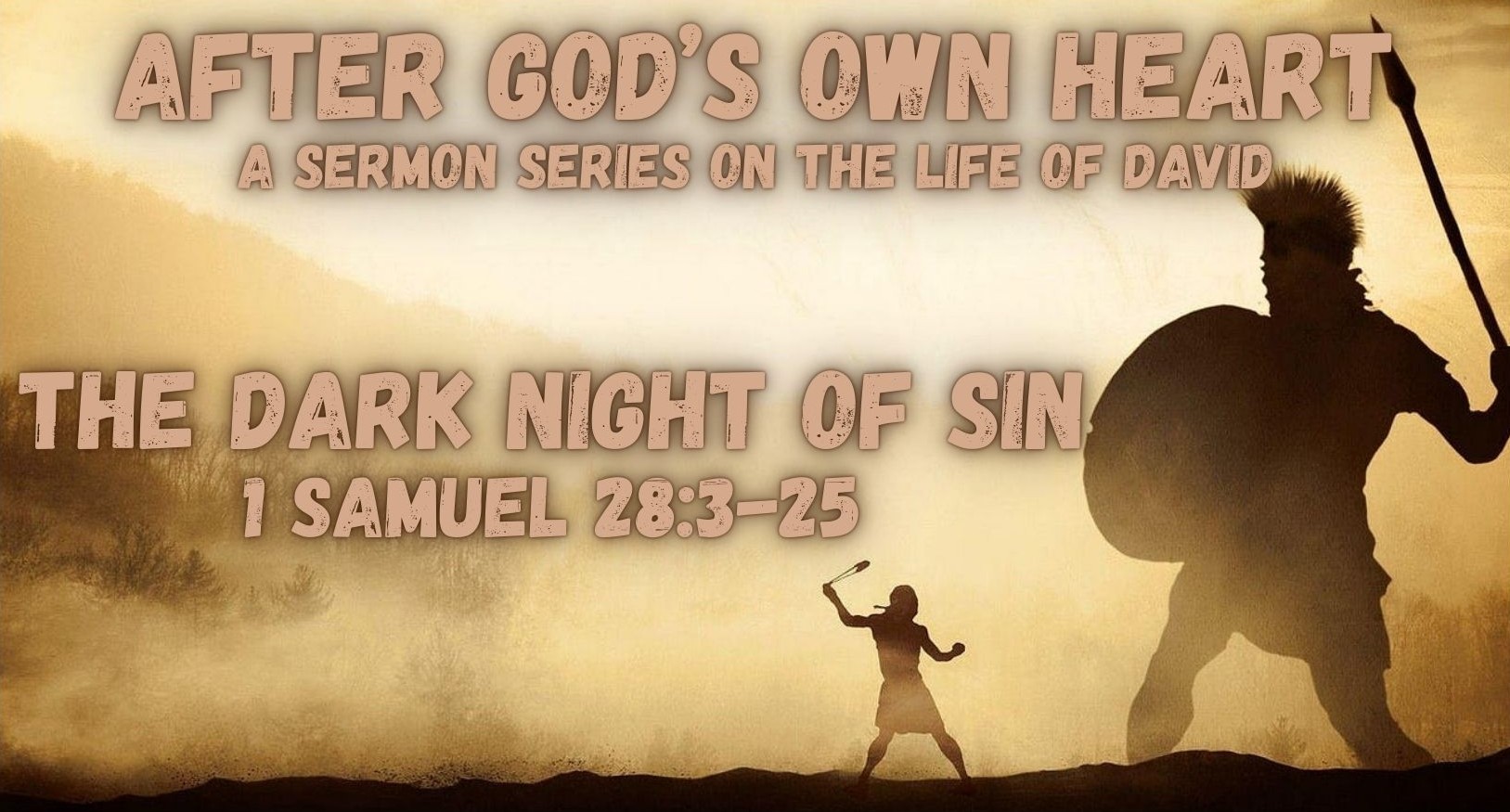
1 Samuel 28:3-25
3 Now Samuel was dead, and all Israel had lamented him, and buried him in Ramah, even in his own city. And Saul had put away those that had familiar spirits, and the wizards, out of the land. 4 And the Philistines gathered themselves together, and came and pitched in Shunem: and Saul gathered all Israel together, and they pitched in Gilboa. 5 And when Saul saw the host of the Philistines, he was afraid, and his heart greatly trembled. 6 And when Saul enquired of the Lord, the Lord answered him not, neither by dreams, nor by Urim, nor by prophets. 7 Then said Saul unto his servants, Seek me a woman that hath a familiar spirit, that I may go to her, and enquire of her. And his servants said to him, Behold, there is a woman that hath a familiar spirit at Endor. 8 And Saul disguised himself, and put on other raiment, and he went, and two men with him, and they came to the woman by night: and he said, I pray thee, divine unto me by the familiar spirit, and bring me him up, whom I shall name unto thee. 9 And the woman said unto him, Behold, thou knowest what Saul hath done, how he hath cut off those that have familiar spirits, and the wizards, out of the land: wherefore then layest thou a snare for my life, to cause me to die? 10 And Saul sware to her by the Lord, saying, As the Lord liveth, there shall no punishment happen to thee for this thing. 11 Then said the woman, Whom shall I bring up unto thee? And he said, Bring me up Samuel. 12 And when the woman saw Samuel, she cried with a loud voice: and the woman spake to Saul, saying, Why hast thou deceived me? for thou art Saul. 13 And the king said unto her, Be not afraid: for what sawest thou? And the woman said unto Saul, I saw gods ascending out of the earth. 14 And he said unto her, What form is he of? And she said, An old man cometh up; and he is covered with a mantle. And Saul perceived that it was Samuel, and he stooped with his face to the ground, and bowed himself. 15 And Samuel said to Saul, Why hast thou disquieted me, to bring me up? And Saul answered, I am sore distressed; for the Philistines make war against me, and God is departed from me, and answereth me no more, neither by prophets, nor by dreams: therefore I have called thee, that thou mayest make known unto me what I shall do. 16 Then said Samuel, Wherefore then dost thou ask of me, seeing the Lord is departed from thee, and is become thine enemy? 17 And the Lord hath done to him, as he spake by me: for the Lord hath rent the kingdom out of thine hand, and given it to thy neighbour, even to David: 18 Because thou obeyedst not the voice of the Lord, nor executedst his fierce wrath upon Amalek, therefore hath the Lord done this thing unto thee this day. 19 Moreover the Lord will also deliver Israel with thee into the hand of the Philistines: and to morrow shalt thou and thy sons be with me: the Lord also shall deliver the host of Israel into the hand of the Philistines. 20 Then Saul fell straightway all along on the earth, and was sore afraid, because of the words of Samuel: and there was no strength in him; for he had eaten no bread all the day, nor all the night. 21 And the woman came unto Saul, and saw that he was sore troubled, and said unto him, Behold, thine handmaid hath obeyed thy voice, and I have put my life in my hand, and have hearkened unto thy words which thou spakest unto me. 22 Now therefore, I pray thee, hearken thou also unto the voice of thine handmaid, and let me set a morsel of bread before thee; and eat, that thou mayest have strength, when thou goest on thy way. 23 But he refused, and said, I will not eat. But his servants, together with the woman, compelled him; and he hearkened unto their voice. So he arose from the earth, and sat upon the bed. 24 And the woman had a fat calf in the house; and she hasted, and killed it, and took flour, and kneaded it, and did bake unleavened bread thereof: 25 And she brought it before Saul, and before his servants; and they did eat. Then they rose up, and went away that night.
Billy Graham and Charles Templeton were once friends. They were referred to as the “Gold Dust Twins” as leading evangelists in the 1940s. Both started out with great promise as evangelists who would proclaim the gospel to large crowds. Of the two, Charles Templeton was often thought of as the more dynamic and charismatic of the two speakers. He was very gifted at communication and of keeping a crowd’s attention. Early on, he had larger crowds and a bigger following than Graham. However, in the process of time, Charles Templeton began to doubt the Christian faith and his skepticism led him to reject the authority of the Bible. Before long Templeton left the true Christian faith and became a journalist, author, and TV personality. In contrast, Billy Graham became the widely known evangelist and preacher of the gospel who did not waiver from His conviction on the inerrancy of Scripture. Of Graham, Templeton once said, “There is no feigning in him: he believes what he believes with an invincible innocence.” What happened to Templeton? What do we make of this?
There are a lot of similarities between the two and the difference between the two “kings” in 1 Samuel, David and Saul. Saul had the charisma and stood “higher than any of the people from his shoulders and upward” (1 Samuel 10:23). He looked the part of king and was a towering figure that the people of Israel trusted to lead them into battle. In contrast, David was a young shepherd boy that even his own family never suspected to be king. His father Jesse didn’t even call for him when Samuel came to anoint one of his sons to be king. Samuel had to be told “Look not on his countenance, or on the height of his stature” because Samuel would have been tempted to choose another of Jesse’s sons as king. We find in the course Saul and David’s lives that Saul was rejected by the Lord as king and David was chosen. Despite his promise and a start marked by removing witches and leading Israel into victory in battle, Saul’s character began to show through and reveal his heart to be far from the Lord. In contrast, David’s heart was revealed to be after the Lord’s “own heart” (1 Samuel 13:14). The same thing that happened to Charles Templeton happened to Saul…sin. Saul began his career with great promise, continued on to great decline, and would see its great end in the remaining chapters of 1 Samuel. His lowest point came in the passage before us, 1 Samuel 28:3-25. In this portion of Scripture, we see the danger of unrepentant sin and of a heart never surrendered to the Lord. Even if a life appears outwardly righteous and promising to everyone else, such a life as Saul’s inevitably ends in ruins before the bar of God’s judgment. From Saul’s example, we learn four dangerous principles of where unrepentant sin leads. We will examine two this week and two next week.
First, we learn that sin leads to blinding hardness. After being spared by David twice, Saul never relented of His murderous pursuit of him. Despite having clear revelation that David was a righteous man and God’s anointed king, Saul still tried to hunt him down. Yet, David went down into Philistia to evade Saul and Saul wanted no part of the Philistines. Further, the Philistines gathered in battle against Israel. While David had his own dilemma because he had joined himself to Achish in fear and deceit, Saul faced a full-scale assault from the Philistines. Driven by fear, Saul tried to do something he had neglected to do for the vast majority of his kingship; he tried to inquire of the Lord. The passage opens in verse 3 with a reminder that Samuel had died (also 1 Samuel 25:1). Samuel had been God’s spokesman to Saul and all of Israel for many years and now he was gone. In addition, Saul had persecuted and killed the priests at Nob, so if there were any priests alive in Israel, they were likely fearful to help him. With no prophet of the Lord (Gad the seer was with David) and no priest to inquire for him (Abiathar was also with David), Saul had alienated himself from hearing from God through his sinful rebellion. Samuel had departed him because of his disobedience in 1 Samuel 15. The prophets in Ramah had seen the sign of God’s judgment on him in 1 Samuel 19 when the Spirit came upon him and caused him to strip naked and prophesy. Saul was truly alone and by his own doing. We may think that sin will surround us with friends. We may think it will enable us to hold onto power, to fit in, or manipulate our circumstances in our favor, but all sin does is alienate us. Saul was flying blind, so to speak. He had no guidance from the Lord. That is where sin leads. Even what we gain by way of sin is a façade because it is built on lies. Psalm 66:18 tells us, “If I regard iniquity in my heart, the Lord will not hear me.” That means that if we pray to God with sinful motives or unrepentant sin, He does not listen. Why? It is because He will not reveal more of His will to us when we are being deliberately disobedient to His will already. James called such an attitude “doubleminded” (James 1:5-8). When a person chooses to persist in sin, they are left increasingly blinded. Saul didn’t want to follow the Lord’s guidance and commands. He had continually ignored what he knew to be right and God gave him over to the way he had chosen.
Next, we learn that sin leads to unthinkable action. How far would Saul’s sin take him? The answer comes in verse 7. He asked his men to find him “a woman that hath a familiar spirit.” He went about to consult a witch! Instead of inquiring of the Lord, he inquired of a witch at Endor. Knowing that his actions were wrong, Saul went under cover of night, changed his clothes, and disguised himself to go visit the witch. What is remarkable is that Saul started his kingship persecuting witches and similar sinful things. He removed the witches from Israel. Now, he was going to consult one. A. W. Pink once accurately wrote about this, “It illustrates the fact that apostates frequently commit those very sins which they once were most earnest in opposing.” It would be like ardently opposing a false teacher in the church today that you see on television, but then joining yourself to one locally. When a person operates from pride, what follows is rebellion. What then follows that prideful rebellion is blatant hypocrisy and, many times, the person is blind to it. Samuel had warned Saul about his rebellious attitude when he said, “For rebellion is as the sin of witchcraft, and stubbornness is as iniquity and idolatry” (1 Samuel 15:23). Rebelliousness and “stubbornness” are, in God’s eyes, the same as “witchcraft” and “idolatry.” Saul’s rebellion led him to witchcraft. Samuel was right. If there is a warning we must heed in this passage, it is that the smallest of sins and rebellion in our lives must be squashed or they will lead us to do the unthinkable. When we persist in our sin in pride, our lives will be marked by things we never thought possible. What do we do? We must bring our sin to the light and confess it to God and others (if necessary) (1 John 1:9; Matthew 5:23-24). John 3:21 says, “But he that doeth truth cometh to the light, that his deeds may be made manifest, that they are wrought in God.” Bring your sin to the light. Even the witch tried to warn Saul about his own law, even though she didn’t know it was Saul consulting her. She reminded him that what he was asking her to do was illegal. As if matters couldn’t get worse for Saul, he responded by assuring her that no harm would come to her. He assured her by swearing on the Lord that “no punishment” would come upon her. Do you see that? He went from persecuting witches to swearing by the Lord to protect one. The greatest mark of unrepentant sin in a person’s life is a deliberate lie to cover it. If someone commits a sin or error and lies about it, that is a sign of where there heart truly is before God. Instead of humbling himself before the Lord and entrusting himself to God’s mercy, Saul ended up trying to circumvent the Lord by hiring a witch to conjure up Samuel (v. 11) so that he could hear from God’s prophet once more. This quote from Richard Phillips puts it well: “What a dreadful state to recognize the need for truth from God while being too hardened to come to God himself!”
What sin are you holding onto and not bringing to the Lord? What sins have you committed against others that you have not sought reconciliation in? Sin is a deceiver (Hebrews 3:13). Many pastors have said this famous quote, “Sin will take you farther than you want to go, keep you longer than you want to stay, and cost you more than you want to pay.” There is still hope if the Spirit of God convicts your heart and conscience today over these matters. That means He desires you to come to Him and surrender. “To day if ye will hear his voice, harden not your hearts” (Hebrews 3:7-8). Avoid the blinding hardness and the unthinkable actions. Embrace the freedom that comes from bringing it all into the light. Come to Christ today.